

Ghost hunting has taken a few forms but it has never been far from humanity’s efforts. most civilizations, as far as we can work out, had some version of honoring their dead and coaxing the spirits to a new realm–or to revisit ours. In the modern era, spooks donned white shrouds and appeared at dim séances bringing warnings or messages from beyond. They stumbled around creaky homes and bare ruins, perpetually in search of a missing life.
Alice Vernon looks at our history of ghosts through a social lens: why do we keep looking for spirits, and what does our curiosity say about the living?
What has always struck me is the stubborn inability of early investigators and skeptics to find middle ground. This is so well exemplified by the close friendship, then falling out, of Sir Arthur Conan Doyle and Harry Houdini. In our digital age, it is simpler to hear stories of theatrical trickery and candlelit dinner parties and decide it was foolishness. But outside of this veneer of slick performance was a dedicated and under-recognized cadre of scientists and philosophers attempting to apply rigorous research techniques to ghost hunting. They saw no reason why it should be treated any differently than the search for a new element or the discovery of a new creature. And they have a point.
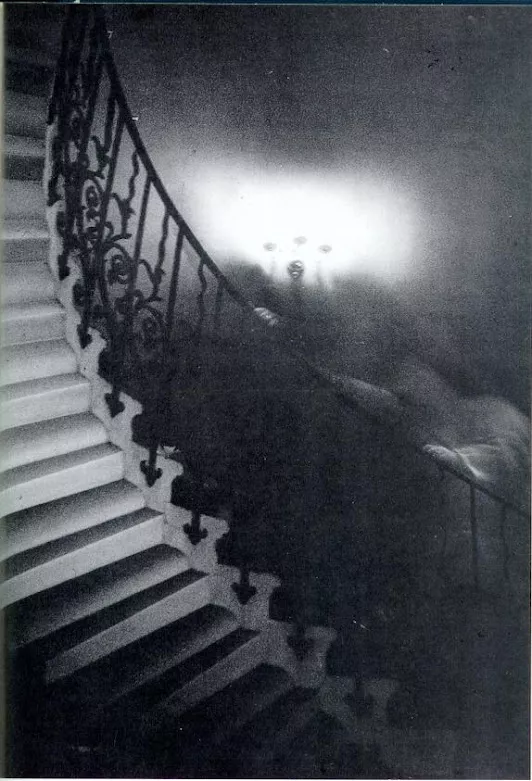
The problem is ghosts are inherently unpredictable, making reproducible results (a hallmark of a sound scientific experiment) nearly impossible. Early photography hoped to solve that, at least partially, by creating a permanent record of occurrences, assuming they could be caught at all.

Vernon decides to research this history as well as pursue some ghosts in our time. She joins hunts, gets certified, and talks to spirit hunters. She admits she starts with a bit of cheekiness, in it for the fun but not expecting much. But the longer she spends with hunters, the more she realizes that is about the living, not the dead.
Ghost hunting, I’ve found, is very much about yearning. It’s a physical, tangible action towards something inherently metaphysical and intangible; it allows us to lessen the gap between the living and the dead, to bring us closer to the loved ones we’ve lost. ~Pg. 111
Vernon uses key points in parapsychological history and research as a jumping off point for each chapter. She uses these topics–haunted houses, séances, poltergeists, ghost labs–to explore their place in the realm of spirit studies and how they contribute to (or degrade) to discourse of ghost hunting.
I absolutely devoured this book in an afternoon and evening. It struck the right balance of academic research, history, and reflection. It doesn’t seek to prove the (non)existence of ghosts. It doesn’t try to convince the reader of anything, other than to show that ghost hunting is more varied and complicated than you ever thought.
My thanks to Bloomsbury for the early reader copy.
Publisher: Bloomsbury Sigma
Publication date: September 2, 2025
Print length: 304 pages (English)
ISBN-10: 139941870X